Padel scores exactly like tennis, serves like nothing else you’ve played, and lets you hit the ball off the glass — those three facts cover most of what a new player needs. The rest is detail you’ll absorb in your first hour on court. Here’s the version that gets you playing, plus the rule change the sport made in 2026.
The five rules that matter on day one
- Serve underhand, below your waist, after one bounce — diagonally into the opposite service box.
- One floor bounce. The ball may bounce once on your side. Twice and you’ve lost the point.
- Your own walls are in play. After the ball bounces, it can come off your glass and you can still return it.
- Scoring is tennis scoring. 15, 30, 40, game. Six games take a set.
- You’re playing doubles. Almost always. Singles padel exists but the court isn’t built for it.
Everything below is elaboration on those five. If you read nothing else and walk onto a court tonight, you will not embarrass yourself.
Court anatomy, and why it dictates the rules
Padel’s rules only make sense once you can picture the box you’re standing in, so it’s worth thirty seconds on the geometry.
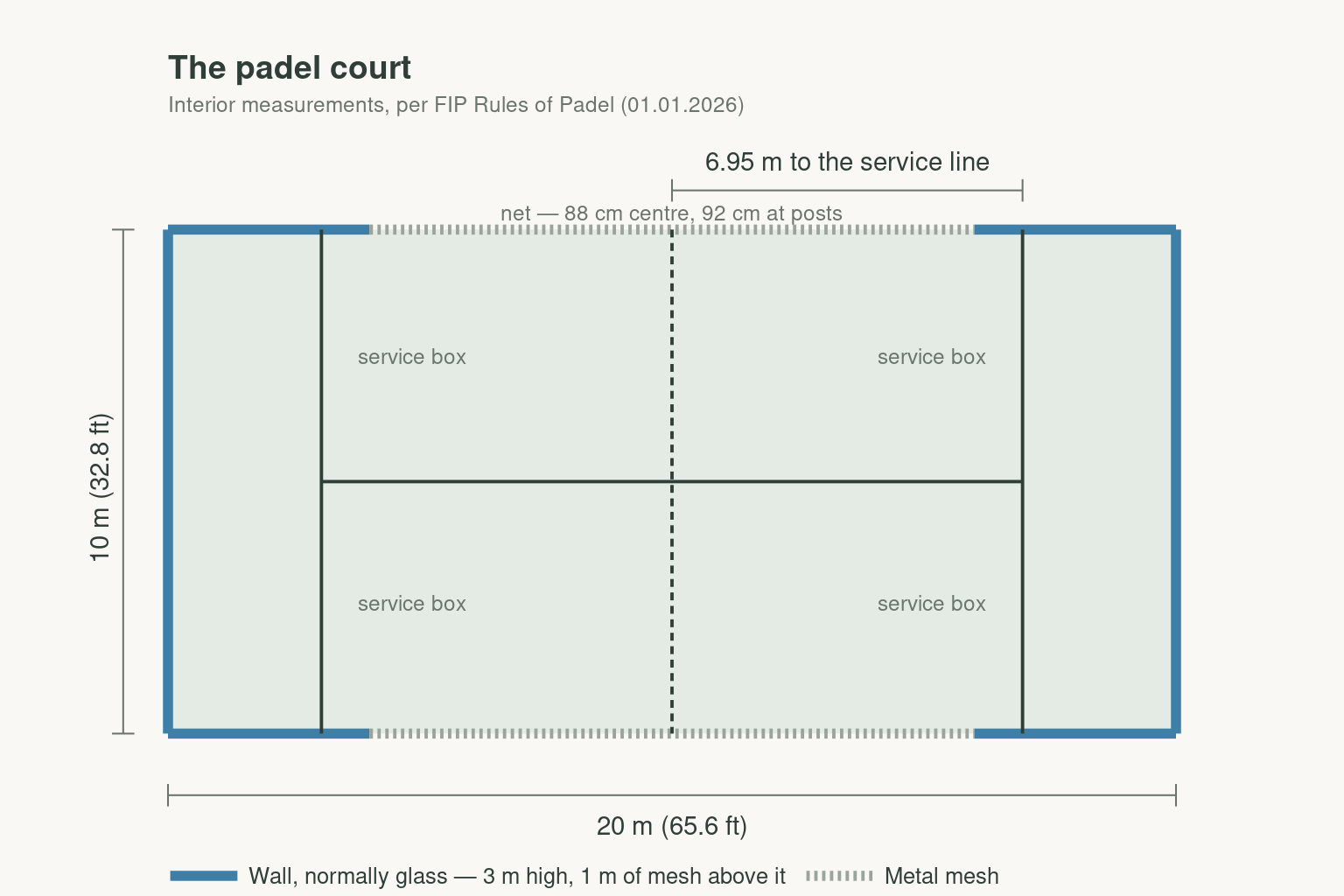
A padel court is a 20 by 10 meter rectangle — roughly 66 by 33 feet, measured inside the enclosure — and it is enclosed on every side. At each end the enclosure stands 4 meters tall: the bottom 3 meters is wall, normally tempered glass, and the top 1 meter is metal mesh. Down the sides, the wall panels sit in the two end zones and metal mesh completes the rest of the run. A net divides the court across the middle, and each half is marked with a service box on either side of a center service line.
Three details do most of the work:
- The service line sits 6.95 meters back from the net — a shade over 3 meters in from the back glass. That is a short service box by tennis standards, which is part of why the underhand serve is enough to be effective.
- The net is lower than a tennis net — 88 cm at the center, rising to 92 cm at the posts, against tennis’s 91.4 cm and 107 cm. Low net, enclosed court, no run-off: the rally lasts longer than tennis instinct expects.
- The playing surface is artificial turf, usually sand-dressed. It is slower than a hard court and the bounce is lower, which again keeps rallies alive.
The enclosure is not a fence around a court. It is the court. Every wall rule below follows from that.
Serving
The serve is where padel departs furthest from tennis, and it’s a common source of first-session corrections.
You stand behind the service line, feet between the center line and the side wall, both feet on the ground and behind the line at the moment of contact. You bounce the ball once on the ground, then strike it at or below waist height. The contact must be underhand — no overhead serving, ever, at any level of the sport.
The ball travels diagonally into your opponent’s service box, same as tennis. After it lands in the box, it may touch the side or back glass and stay in play — this is normal and the receiver is expected to deal with it. What the serve may not do is strike the metal mesh on the full, or touch the mesh at any point before the ball has bounced in the box.
You get two serves. Two consecutive faults hand the point to the receiving team.
The serve sequence, in order
- Right box first. The first point of every game is served from the server’s right-hand side into the receiver’s diagonally opposite box.
- Alternate every point. Right, left, right, left, for the whole game.
- The serving team alternates servers between games, and partners keep the same order through a set.
- The receiving pair holds its sides for the whole game. You don’t swap receiving boxes mid-game.
- Change ends after every odd-numbered game — after game 1, 3, 5, and so on.
Service faults, lets, and the ones people argue about
- Fault — the serve misses the box, is struck above waist height, is struck overhead, bounces twice before you hit it, or hits the mesh before bouncing in the box.
- Foot fault — a foot touches or crosses the service line, or steps outside the center-line/side-wall channel, before contact.
- Let — the serve clips the net cord and still lands correctly in the box. Replay that serve, no penalty. This is the one most tennis players already know.
- Fault, not a let — the serve clips the net cord, lands in the box, and then hits the mesh. Net cord plus mesh is a fault, not a let.
Scoring, and what changed in 2026
Padel borrowed tennis scoring wholesale:
| Points won | Called |
|---|---|
| 0 | Love |
| 1 | 15 |
| 2 | 30 |
| 3 | 40 |
| 4 (with a two-point lead) | Game |
Six games win a set, and you must win by two — 6–4 takes a set, 6–5 does not. Matches are usually best of three sets, with a tiebreak at 6–6 working as it does in tennis: first to seven points, win by two, and you change ends every six points.
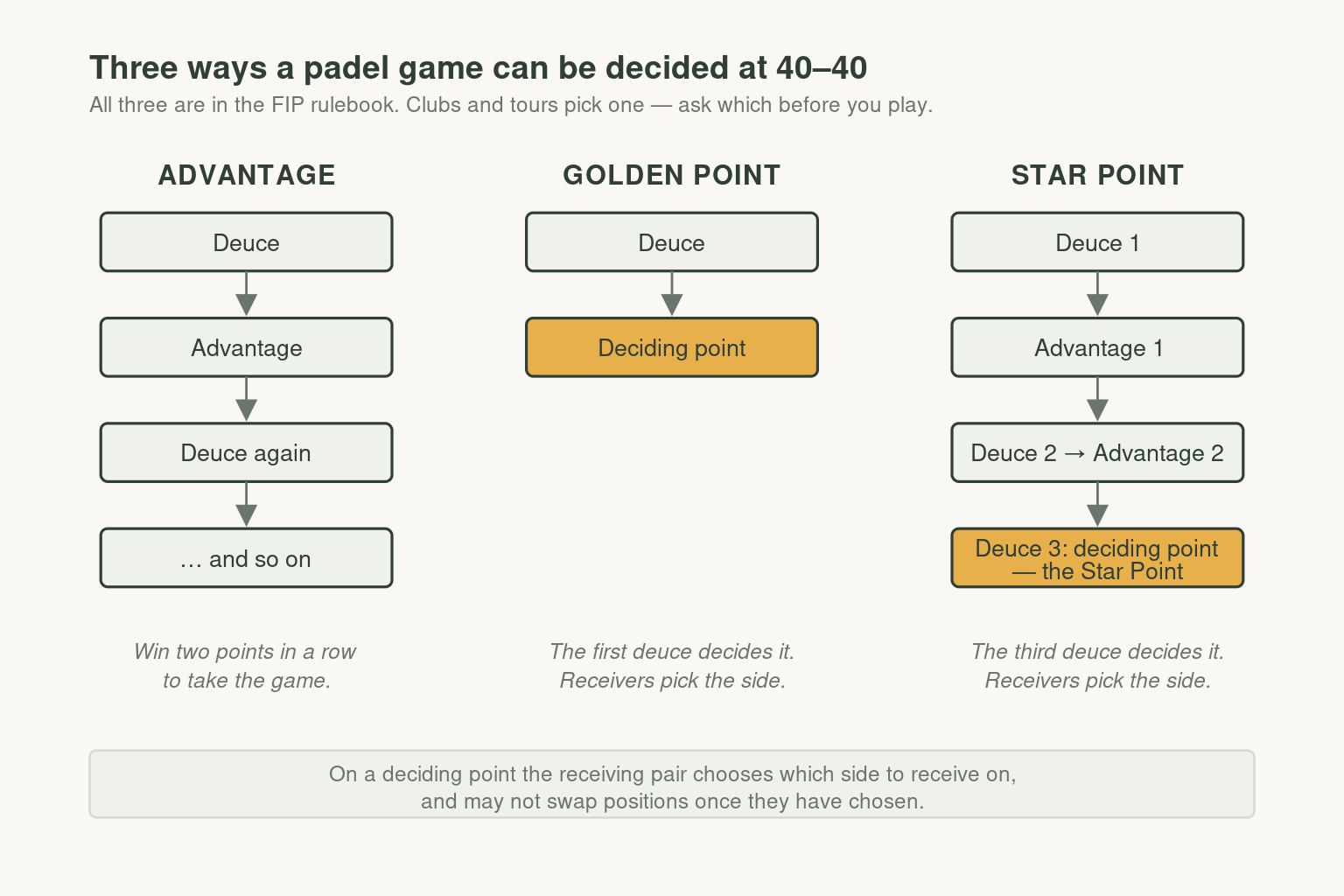
The 2026 change is at deuce. When both teams reach 40, the International Padel Federation now sanctions three formats, and clubs choose which to run:
- Advantage — the classic. Win two consecutive points from deuce to take the game. Games can run long.
- Golden Point — a single deciding point at the first deuce. The receiving pair chooses which side receives it. Fast, and widely used in club play because it keeps courts turning over.
- Star Point — the 2026 addition, and a compromise between the two. The game runs deuce, advantage, deuce, advantage, and only at the third deuce is a single decisive point played. The receiving pair chooses which side receives it, and the receivers may not switch positions.
Star Point is the format the FIP has deployed across Premier Padel and the CUPRA FIP Tour for 2026, so it’s the one you’ll see in professional matches. Club play still varies — we don’t track deuce format club by club, so it’s a desk question rather than something you can look up.
Here is the honest practical consequence: the deuce format changes how long you wait for a court. A club running Advantage on eight courts on a Tuesday night will run later than the same club on Golden Point, and that is usually why a facility picks one. If you’re booking around a hard stop, ask.
The walls — the rule that makes padel padel
This is the concept with no equivalent in tennis, and it’s simpler than it first appears.
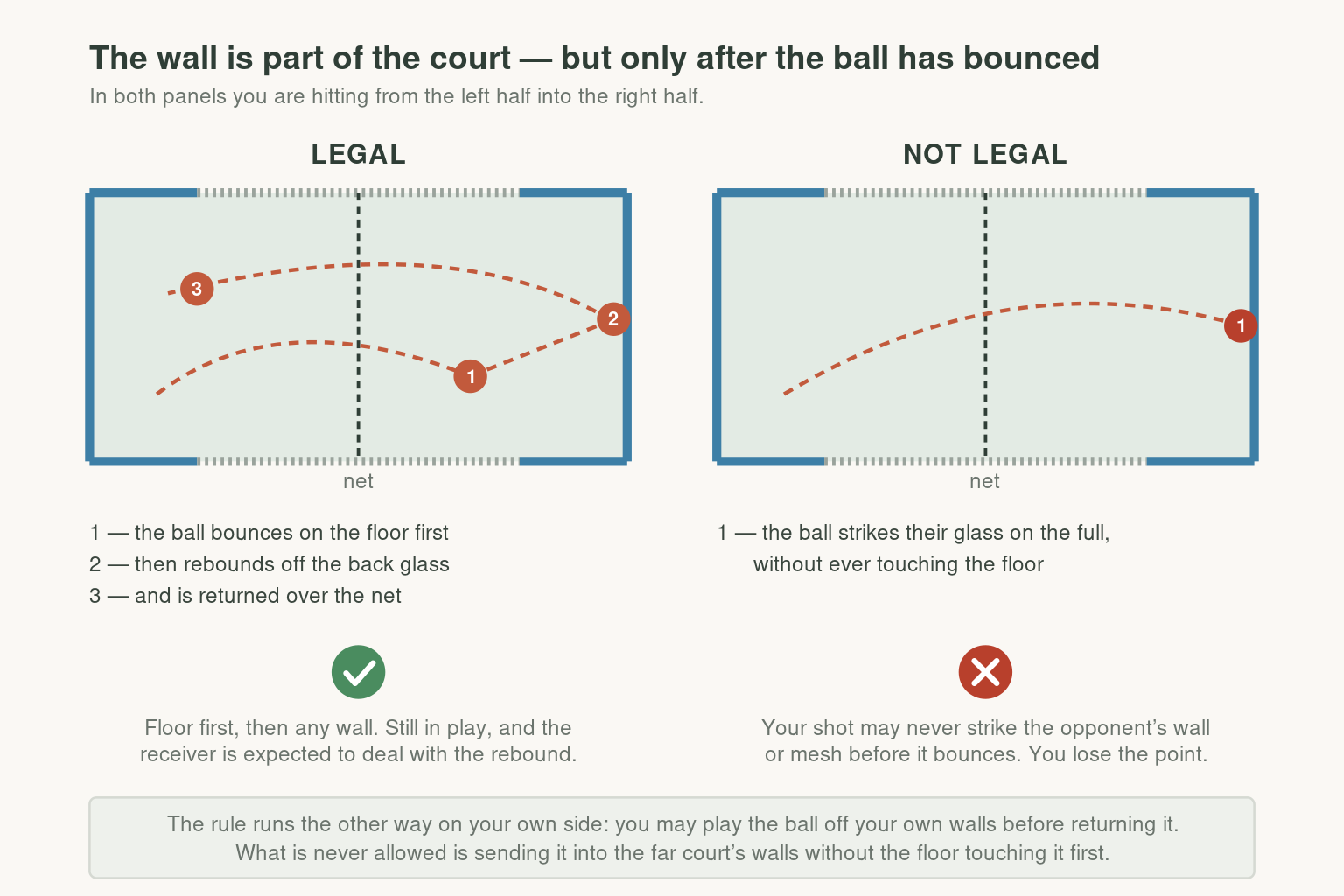
On your own side: after the ball bounces on your floor, it can hit any of your walls and you can still play it. A ball rocketing past you into the back glass is not a lost point — it’s a normal rally. Letting the ball come off the glass and hitting it on the return path is a foundational padel skill.
On your opponent’s side: the ball you hit must bounce on their floor before it touches their glass. If your shot hits their wall on the full, with no floor bounce first, you lose the point.
Off the court entirely: on courts with an outside gate, a ball that bounces in and flies out over or around the enclosure can, at some clubs, be chased and returned from outside the court. This is the por cuatro, and whether it’s permitted is a house rule — confirm it at your club rather than assuming.
The metal mesh counts as a wall for these purposes, but the ball rebounds off it far less predictably than off glass — the surface is uneven, so the angle out is less reliable than the angle in would suggest.
Four situations, resolved
Most wall arguments are one of these four:
| What happened | Ruling |
|---|---|
| Ball bounces on your floor, hits your back glass, you return it over the net | Legal. The most common rally pattern in the sport. |
| Ball bounces on your floor, hits your back glass, then your side glass, you return it | Legal. There is no limit on how many of your own walls it touches after the floor bounce. |
| Your shot crosses the net and hits their back glass before bouncing on their floor | You lose the point. Floor first, always, on their side. |
| Their shot bounces on your floor, hits your glass, and bounces on your floor a second time before you reach it | You lose the point. The wall doesn’t reset the bounce count. One floor bounce is one floor bounce. |
That last row is the one that catches people. The walls extend the rally; they don’t extend your allowance.
Faults and lost points
You lose the point when:
- Double bounce — the ball bounces twice on your side of the court.
- Into the net — your shot fails to cross.
- Wall before floor — your shot hits your opponent’s wall before bouncing on their floor.
- Body contact — the ball touches you or your partner.
- Net or post contact — you touch the net, a post, or your opponent’s side of the court.
- Reaching over — you hit the ball before it crosses the net.
- Double hit — you and your partner both make contact on the same shot, or one player hits it twice.
- Double fault — two consecutive service faults.
You do not lose the point when the ball hits your own walls after bouncing, or when it clips the net cord on a rally shot and lands in.
How padel differs from tennis, in one table
If you already play tennis, this is the fastest way in:
| Padel | Tennis | |
|---|---|---|
| Serve | Underhand, below waist, after a bounce | Overhead, no bounce |
| Walls | In play after the floor bounce | No walls |
| Scoring | 15/30/40, game — plus three sanctioned deuce formats from 2026 | 15/30/40, game |
| Format | Doubles, effectively always | Singles or doubles |
| Racket | Solid, perforated, no strings | Strung |
| Surface | Artificial turf, low slow bounce | Hard, clay, or grass |
| Court | 20×10 m enclosed, no run-off needed | Larger, plus substantial run-off |
The last row is the one with money attached. We break down what building a court actually costs here.
If you want the longer version of this comparison against the racket sport most Americans have actually played, we’ve written padel vs pickleball separately.
Equipment rules
- Racket — solid and perforated, no strings; the face is drilled with holes of 9 to 13 mm. Head plus handle may not exceed 45.5 cm long, 26 cm wide or 38 mm thick. It must carry a non-elastic wrist cord of no more than 35 cm, and that is an actual rule referees enforce in sanctioned play, not a safety suggestion — under FIP Rule 13, a pair whose player breaks the cord or drops the racket loses the point on the spot.
- Ball — a rubber sphere 6.35 to 6.77 cm across weighing 56 to 59.4 grams, dropped from 2.54 m it must bounce 135 to 145 cm. Slightly smaller and slightly lower-bouncing than a tennis ball, which is what keeps rallies inside the walls. Only FIP-approved padel balls are permitted in official competition.
- Shoes — no rule governs footwear. Padel is played on artificial turf, and herringbone and omni sole patterns are the ones manufactured for that surface. Flat-soled court shoes will work and will slide more than you want.
- Clothing — no rulebook requirement in club play. Some clubs have their own dress code; almost none enforce it socially.
Nearly every US club rents or lends rackets, and most include balls in the court fee. You do not need to buy equipment to try padel, and buying a racket before your third session is a good way to buy the wrong racket.
The vocabulary you’ll hear on court
None of these are rules, but not knowing them makes the first session harder than it needs to be:
- Bandeja — the controlled overhead used to keep the point going rather than end it. The most-taught shot in the sport.
- Víbora — a sharper, more aggressive cousin of the bandeja, hit with sidespin.
- Bajada — a shot played off your own back wall after the ball rebounds.
- Contrapared — hitting the ball into your own wall deliberately to send it back over the net. Legal, occasionally the only option.
- Chiquita — a soft, low ball played at the feet of an opponent at the net.
- Por cuatro — the out-of-court return described above, where the club permits it.
House rules, and why they exist
If you’re playing socially, your club’s house rules will matter more to you than the rulebook. The three that vary most:
- Deuce format — Advantage, Golden Point, or Star Point, chosen by the club, usually for court-turnover reasons.
- Out-of-court returns — permitted at some facilities, forbidden at others, often for insurance rather than sporting reasons.
- Warm-up and changeover time — entirely local, and it’s what determines whether your 60-minute booking is actually 60 minutes of play.
Ask at the desk. Nobody minds, and every regular asked the same question once.
Where the rules come from
The International Padel Federation publishes the official rulebook and updates it periodically — the 2026 revision added the deuce options above. US clubs generally follow FIP rules, with local variation on deuce format and on whether outside-the-court returns are permitted at that facility.
Ready to find a court? Our directory covers verified padel clubs across 36 states, every one sourced and date-stamped — Florida and Texas have the deepest coverage. If your state is thin, more projects are in the pipeline, many of them already in construction.
New to the sport entirely? Start with what padel actually is, or see how it compares to pickleball. If you’re on the other side of the sport — building rather than playing — start with what a court costs.
Sources: International Padel Federation Rules of Padel, 2026 edition (deuce formats including the Star Point sequence, court specification, equipment requirements, service and fault definitions) and FIP announcements on Star Point adoption across Premier Padel and the CUPRA FIP Tour; Padel Ledger club directory and construction pipeline, September 2026. Club and court totals are re-verified on a rolling basis and are published on the directory pages themselves rather than quoted here.